Crafting a Balanced Content Marketing Mix: Understanding Earned, Paid, Owned, and Shared Media

My intent is for this blog to help early stage enterprise AI and SaaS companies understand how each channel works together to build brand awareness, convey differentiation and validation, and ultimately drive inbound interest at the bottom of the funnel (BoFu).
Marketing works best when every channel has a job. Paid, owned, earned, and shared media are the core parts of a practical content marketing mix. Some channels bring fast reach. Some build trust. Some nurture leads. And, the holy grail is that some help people spread your message for you. Understanding how marketing tactics work together helps you create campaigns that grow over time.
What do earned, paid, owned, and shared media mean?
Paid, earned, owned, and shared media are labels for the ways your brand reaches an audience and the control you have over the message.
- Owned media is content and channels you control.
- Paid media is placement you buy.
- Earned media is third-party attention you receive.
- Shared media is audience-led distribution through social and community channels.
Together, these media types help marketers balance speed, trust, consistency, and reach.
The mix is a map. A campaign can start with a blog post. It can then use ads to drive traffic and gain shares on social media. Eventually, it can earn backlinks or press mentions. The value comes from planning those links on purpose.
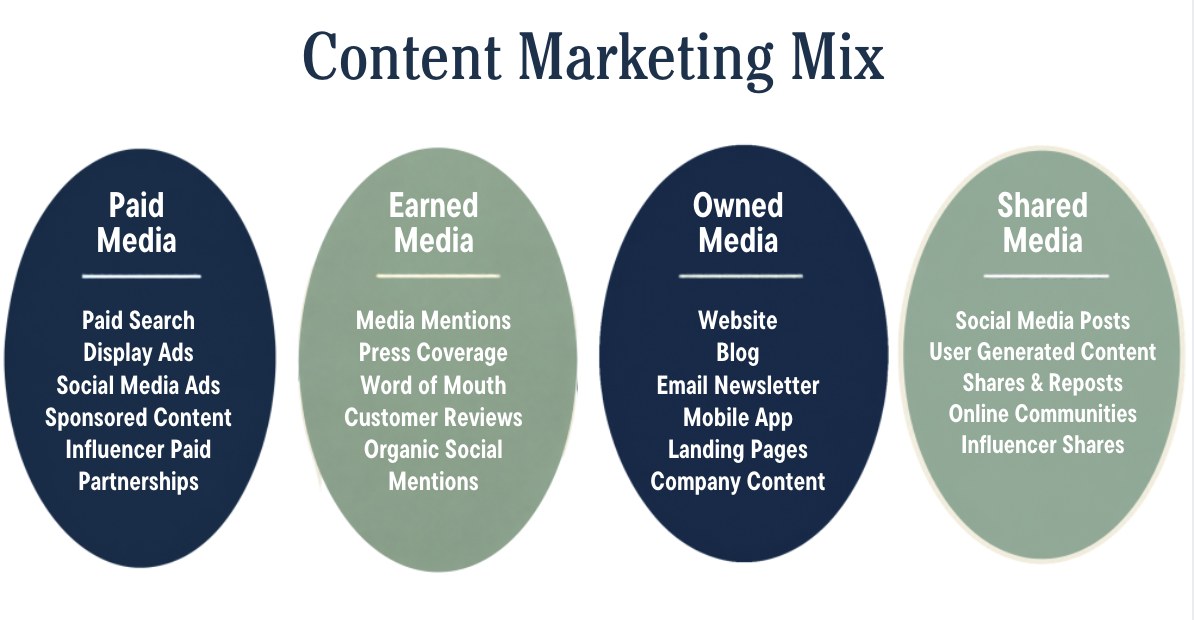
This comparison is useful because many teams overinvest in a certain channel based on comfort level. A content team may keep publishing owned articles without distribution. A paid team may drive traffic but lack strong landing pages. A public relations team may win mentions without a plan to measure or convert the engagement. The best paid, earned, owned, and shared media strategy are designed to have each channel feeding into the next.
Owned media builds the base
Owned media is the material and digital space your brand controls. It covers your website, blog, email list, product pages, guides, webinars, knowledge base, case studies, and landing pages. It also includes your social profiles, even though the platform still controls reach.
The main owned media benefits are control and flexibility. You decide the message, structure, calls to action, internal links, design, and next step. That makes owned content useful for complex topics, buyer questions, sales support, and people who are not ready to convert yet.
Strong owned media also supports discovery. Search engines, AI tools, social platforms, and potential customers need clear info about your brand to understand its value. A thin landing page rarely does that job alone. A strong content hub adds context around your products, customer problems, industry terms, and decision criteria.
Useful owned media tactics include:
- Create content for each stage of the journey.
- Keep important pages current.
- Build topic clusters.
- Use email thoughtfully.
- Make content easy to reuse.
Owned media is rarely enough on its own, especially for newer brands. But it gives every other channel a useful place to send people.
Paid media creates controlled reach
Paid media is any placement you pay for on a third-party channel. This includes paid search, paid social, display ads, sponsored newsletters, native ads, retargeting, podcast sponsorships, and promoted content. Its biggest advantage is speed: you can reach a defined audience faster than waiting for search rankings, shares, or press mentions.
Paid media is helpful for testing messages, launching promotions, targeting specific groups, or boosting successful content. It gives marketers control over targeting, budget, timing, creative, and landing-page destination. That makes paid media a learning tool, not just a traffic source.
The trade-off is trust. People know ads are promotional, so the message may carry less credibility than a recommendation, review, or independent mention. If targeting is too broad, the landing page is weak, or the offer does not match intent, spend is wasted without meaningful results. An example of this lesser credibility is AVE. Media analytics tools provide an earned media metric for Ad Value Equivalency (AVE) that is typically calculated by equating the value of an earned/journalistic article as 3x the dollar value of a paid ad in the same outlet.
A strong paid strategy starts with small tests. Compare messages and audiences. Improve the landing page. Then scale the tactics that work. Paid search may capture active demand, while paid social may create demand by placing a useful idea in front of people before they search. Both can work, but we should not judge them by the same yardstick.
Earned media adds trust
Earned media is attention your brand receives from third parties without directly buying the placement. It can include press coverage, podcast invitations, analyst mentions, organic backlinks, customer reviews, social mentions, community recommendations, and unpaid influencer attention.
That independence is why earned media can be so persuasive. A brand may claim expertise on their website, but proof can come from respected creators or satisfied customers.
- Brands can assert their expertise on their website.
- However, proof can be provided by respected creators.
- Proof can also come from satisfied customers. During the consideration and decision stages, earned media is crucial for providing evidence and reassurance to buyers.
Earned media takes patience because it depends on relevance and relationships. Journalists, creators, community leaders, and site owners need a reason to mention you. A generic pitch rarely works. Valuable information like expert opinions, research, or customer stories is more likely to get noticed.
To improve earned media potential:
- Create something worth citing.
- Build relationships before asking.
- Make outreach specific.
- Support reviews and advocacy ethically.
- Track referral value.
Earned media is less predictable than paid placement, but that is part of its value. When it happens, it often carries trust that advertising cannot easily copy.
Shared media turns audiences into participants
Shared media lives between brand publishing and audience sharing. It includes reposts, comments, user-generated content, community conversations, hashtag activity, creator collaborations, and peer-to-peer recommendations on social platforms. The brand may start the conversation, but the audience helps decide how far it travels.
The opportunity is reached through digital networks. When people share, comment on, or remix content, the message can move beyond your current followers. Shared media can also show what your audience values. If a technical explainer receives thoughtful comments, a customer photo receives strong engagement, or a short tip is widely reposted, that behavior can guide future content choices.
The challenge is control. Platform algorithms change, public conversations can move in unexpected ways, and engagement does not always equal business impact. A shared media strategy must invite participation while remaining tied to clear goals and brand standards.
To share media well, ask engaging questions, use appropriate hashtags, repost user content with permission, and create shareable formats. Short videos, slideshows, ready-made designs, surveys, sneak peeks, and useful advice are effective for engagement. These are some of the best content distribution methods because they let people help carry the message.
How the channels work together
The mix integrates paid, earned, shared, and owned media into one strategy instead of treating them as separate teams. In reality, each campaign needs a core message (conveying benefits to the customer), target metrics, a plan for sharing, and ways for people to connect with you.
Some teams condense the mix to paid owned and earned media, since shared media is the bonus that happens organically when execution of other campaign channels is done well. The order can change, but the idea stays the same. The point is to make your marketing channels work together.
A company launching a new product can use a landing page and blog post, promote them with ads, invite sharing on social media, issue a press release linking to owned content, and work to engage journalists, podcasters, and other influencers for coverage. Each channel plays a different role. Owned media explains the offer, paid media drives targeted attention, shared media expands conversation, and earned media adds validation.
The same idea works for smaller campaigns too. A research-backed blog post can become social posts, a newsletter feature, a paid promotion, a pitch to relevant publications, and a sales asset. The content gains more value when it does not get trapped in one format or channel.
A practical checklist for choosing your mix
Use this quick framework before you decide where to invest.
- If you need traffic quickly: start with paid media, but send visitors to strong owned pages.
- If you need trust: prioritize earned media, reviews, partnerships, and third-party proof (hello cybersecurity).
- If you need long-term efficiency, invest in owned media that can rank, teach, convert, and be reused.
- If you need engagement: build shared media moments that invite participation, not just passive viewing.
- If you have a limited budget: strengthen owned content first, THEN amplify the best pieces with paid and earned support.
- If you are launching something new: combine all four.
- If results are unclear: separate metrics by role instead of expecting every channel to produce leads right away.
A balanced content marketing mix does not mean spending the same amount everywhere. It means each channel has a clear role and a measurable part in the plan.
How B2B campaign budget allocation differs by channel
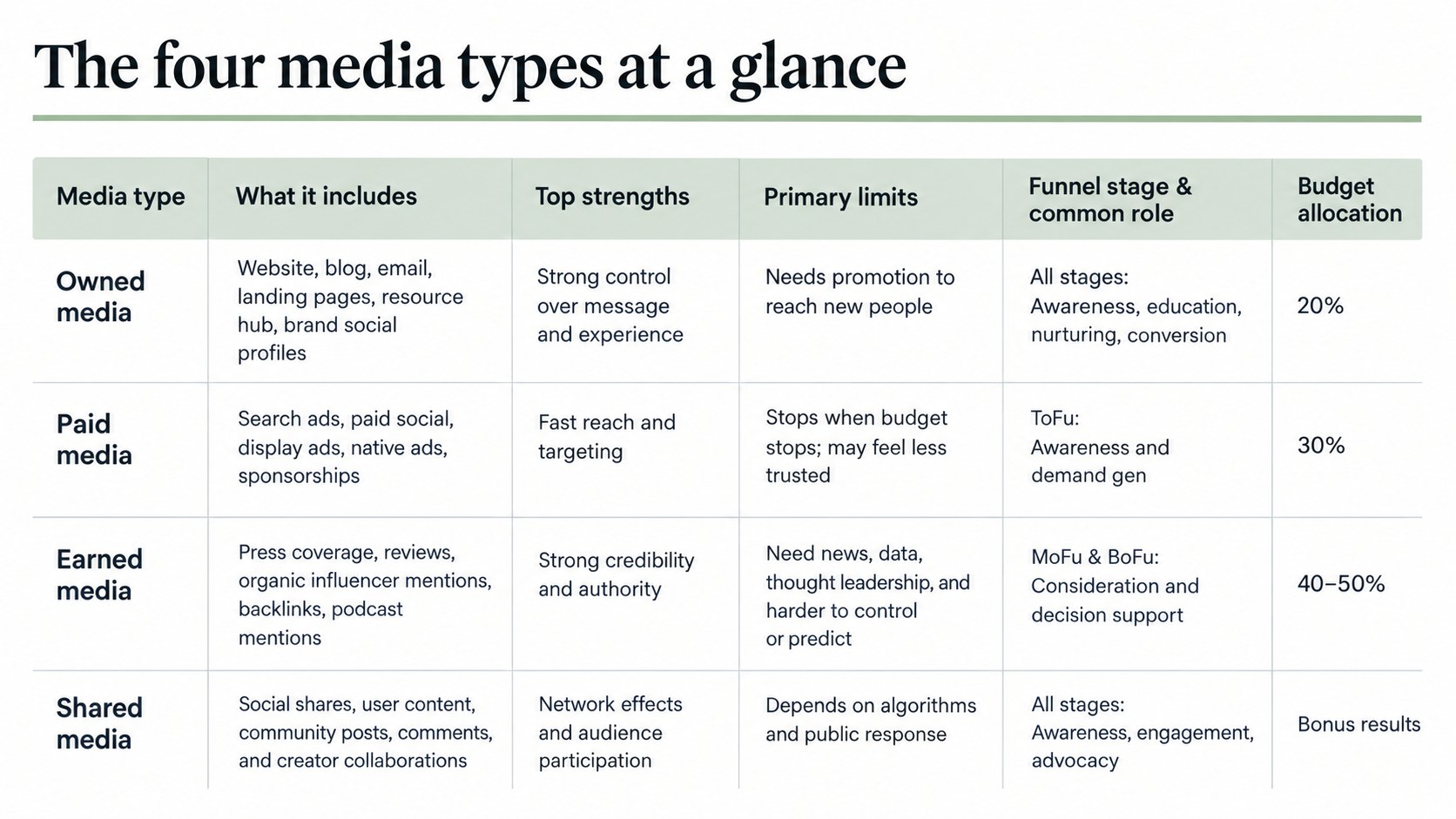
While every marketing campaign budget differs, you can expect to allocate the most on earned media as there is a "PR sales cycle" of sorts that takes internal and agency time; usually 5-6 months when it includes expert thought leadership article placement. See current average PR agency rates (Source: EPRNews). Earned is followed by paid, and then owned. I refer to owned as the least expensive here, provided the content is developed in house. If using external resources, this bucket can quickly eclipse paid media.
Measurement should match the channel
Marketers get frustrated with paid, earned, shared, and owned media because they use the same measurement lens for every channel. That can lead to bad choices. A social post starts discussion, a press mention boosts credibility, and a paid ad generates demo requests.
You can measure owned media through organic traffic, assisted conversions, time on page, newsletter signups, content downloads, internal click-throughs, and lead quality. We should judge paid media based on cost per result, conversion rate, audience quality, creative performance, and return on spend when attribution is clear enough. You can track earned media through referral traffic, backlinks, share of voice, qualified mentions, branded search lift, and sales-team usefulness. Shared media metrics include saves, shares, comments, community growth, user-generated content, and engagement quality.
The key is to connect channel metrics to business outcomes without pretending every outcome is immediate. Some media creates demand. Some capture it. Some build confidence so a buyer moves forward later.
Summing it up: the strongest strategies compound
Paid, owned, earned, and shared media work best when each part reinforces the others. Owned media gives your message a home. Paid media speeds up reach. Shared media helps ideas travel through communities. Earned media builds authority and trust that your brand cannot simply claim for itself.
Start with the audience problem you want to solve, then choose the media mix that fits the goal. When each channel has a specific role, it becomes easier to plan and measure marketing efforts. When your channels support one another each becomes stronger than any tactic alone.
Q&A for startups
Question: Which media type should a newer brand prioritize first?
Short answer: A newer brand should usually strengthen owned media first because it gives every other channel a useful destination. Good website content like pages, blogs, and emails explain offers, answer questions, and boost sales. When you have a base, paid media brings traffic, shared media spreads it, and earned media adds credibility.
Question: Why is paid media described as a learning tool, not just a traffic source?
Short answer: Paid media has a dual purpose. It also lets marketers test messages, audiences, creative, offers, timing, and landing pages quickly. Teams can learn which positioning attracts the right people before scaling spend because they can control and measure campaigns.
Question: How is earned media different from shared media?
Short answer: Earned media is third-party attention your brand receives without directly buying the placement, such as press coverage, reviews, backlinks, podcast mentions, or unpaid influencer attention. Shared media is audience-led distribution and participation, such as reposts, comments, user-generated content, community conversations, and hashtag activity. Earned media mainly adds credibility, while shared media helps ideas spread through networks.
Question: Does a balanced media mix mean investing equally in paid, owned, earned, and shared media?
Short answer: No. A balanced mix ensures each channel has a clear role and purpose, not equal budget or attention. For instance, companies use paid media to quickly reach audiences, owned media for educating and converting them, earned media to build trust, and shared media for engaging with them. The right mix depends on the goal, timeline, budget, and buyer journey stage.
Question: Why should measurement differ by channel?
Short answer: Each media type performs a different function, so you can't use the same metrics for all of them.
- Measure owned media by organic traffic, time on page, assisted conversions, and newsletter signups (ensuring web and demand generation teams share that data).
- Measure paid media by cost per result, conversion rate, and return on spend.
- Evaluate earned media through backlinks, referral traffic, competitive share of voice, campaign key message pull through percentage, and number of mentions by top industry influencers
- Shared media is more nuanced. People may judge results based on comments, saves, shares, community growth, and engagement quality – particularly on LinkedIn.
I welcome the chance to help you design the ideal company or campaign marketing mix. Contact me to discuss your goals and how we get there with strong, targeted messages that fuel growth.