12 Stats Proving Earned and Owned Media Drive Better Inbound
Technology brands are rethinking their mix of earned, owned, and paid media. Enterprise buyers now do most of their vendor research within AI assistants, and those assistants build their answers from earned coverage and expert owned content rather than paid ads.
That single shift has moved communications from a brand awareness line item to the most direct route to qualified inbound traffic, disrupting traditional playbooks. For a decade, the enterprise demand playbook was to buy the click: paid search, paid social, gated content, and retargeting. However, research studies in the past year reveal that this playbook is reaching fewer buyers for the same spend.
Meanwhile, the work communications teams have always done — earning credible third-party coverage and publishing thought leadership content — is now what decides whether a vendor appears organically at all when they ask a machine who to shortlist.
A whopping 84% of citations today stem from earned media. This is great news for not only communications professionals, but the totality of marketing budgets, since earned and owned resources cost far less than digital ad campaigns, SEM, and other paid spend in the quest to drive qualified inbound traffic and leads.
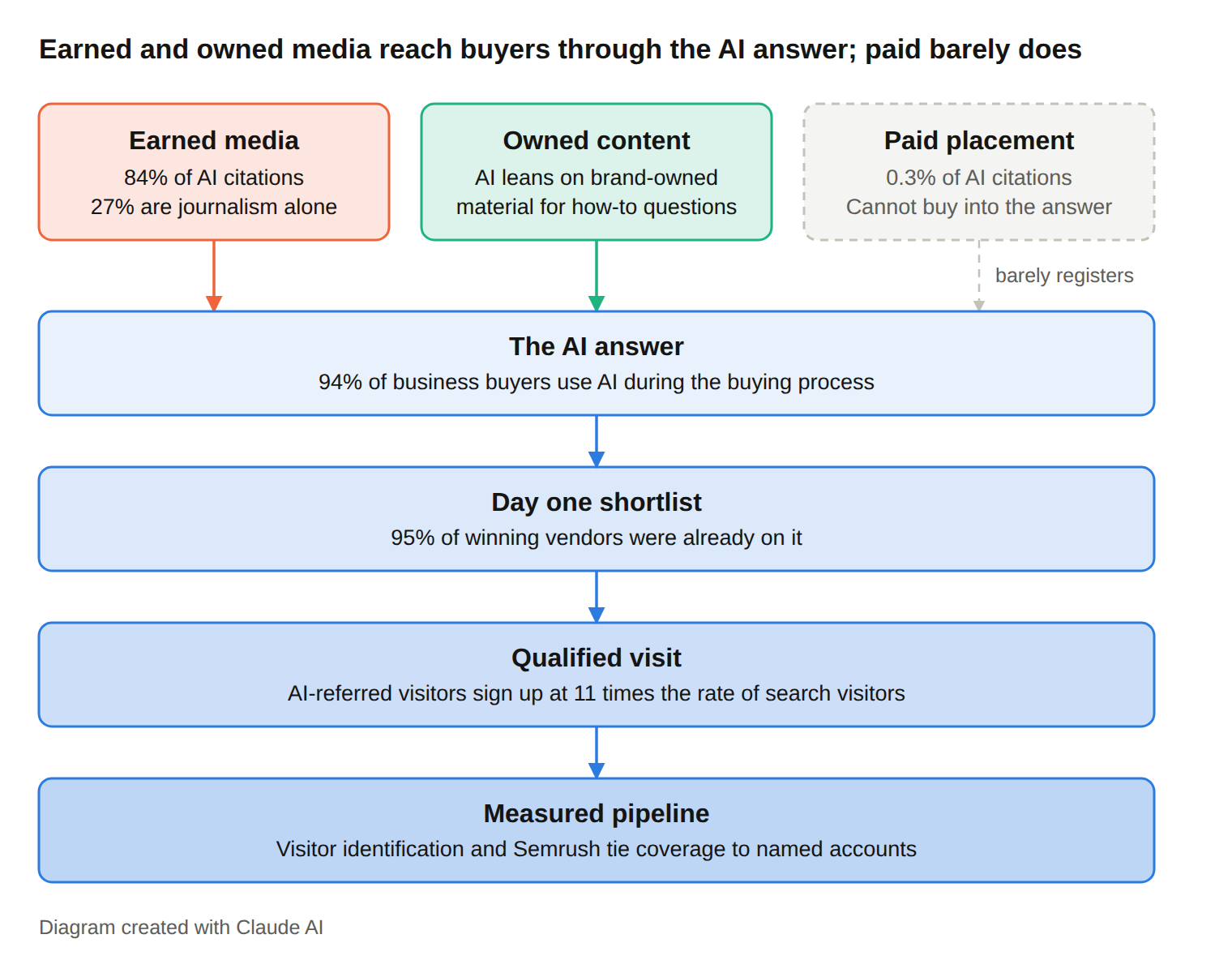
Earned coverage and expert owned content feed the AI answer that shapes the shortlist; paid placement barely enters it. We are in the quality-over-quantity era.
Here are twelve data points from the past year that make the case for communications.
The buyer asks a machine first & the machine reads the press
1. 94% of business buyers use AI during the buying process
Forrester's State of Business Buying, 2026, drawn from a survey of nearly 18,000 global business buyers, found AI use is now close to universal. The same research found buyers check what AI tells them against peers, analysts and industry experts. Both halves of that finding point at communications: the AI answer and the human validators are shaped by third-party credibility, not by ad spend.
Source: The State Of Business Buying: Risk-Averse Buyers Demand Proof, Not Promises, Forrester, Jan. 2026
2. 95% of winning vendors were on the buyer's Day One shortlist
6sense's 2025 Buyer Experience Report found buyers nearly always purchase from a vendor they had in mind before the formal process started, up from 85% in prior years. In fact, 94% of buying groups had ranked their preferred vendors before first contact with a seller. If the shortlist is set before the first search ad is served, what matters is brand reputation built in advance.
Source: The Timeline for Influencing B2B Buyers Is Shrinking: Insights From 6sense's 2025 Buyer Experience Report, 6sense via Business Wire, Nov. 2025
3. 84% of AI citations come from earned media
Muck Rack analyzed more than 25 million links cited by ChatGPT, Claude and Gemini across 17 industries. Earned sources (journalism, research, government and third-party sites) made up 84% of citations, and journalism alone accounted for 27%. Across three studies since July 2025, the earned share has remained between 82% and 89%.
Source: Earned media still drives 84% of AI citations, Muck Rack, May 2026
4. 0.3% of AI citations come from paid or advertorial content
In the same study, but at the opposite end of the spectrum, paid placement is effectively invisible to the assistants your buyers now consult. Ad budget cannot buy a way into the organic answer. Coverage earns it. And, the same study found AI leans on brand-owned material for how-to questions.
Source: Earned media still drives 84% of AI citations, Muck Rack, May 2026
Paid reach is shrinking & owned content has a new job
5. Paid search click-through fell 68% on queries that show an AI Overview
Seer Interactive tracked more than 3,100 informational search terms across 42 client organizations from June 2024 to September 2025. Paid CTRs on queries with an AI Overview dropped from 19.7% to 6.34%. These are the research-stage searches where enterprise buyers form a first impression. In turn, the firm advised CMOs to question whether paying for informational queries is still worth it.
Source: AIO Impact on Google CTR: September 2025 Update, Seer Interactive, Nov. 2025
6. Ranking first on Google now earns 58% fewer clicks when an AI Overview appears
Ahrefs compared 300,000 keywords using Search Console data through December 2025. The top organic result's click-through rate was 58% lower on keywords with an AI Overview, up from a 34.5% reduction measured in April 2025. On those keywords, the top spot now returns well under half the clicks it once did. Owned content still matters, but its job is shifting from winning the click to being the source an answer cites. (See my blog about writing to the prompt).
Source: Update: AI Overviews Reduce Clicks by 58%, Ahrefs, Feb. 2026
7. 47% of tech buyers trust online resources less than they did a year ago
TrustRadius surveyed 1,862 technology buyers for its 2026 B2B Buying Disconnect Report. Declining trust rose to 47% from 39% in a year, and vendor marketing collateral ranked last among the resources buyers consult. Promotional collateral (and ads) are the material buyers discount first, so owned content has to be read as expertise and evidence. Long live thought leadership.
Source: Trust More, Verify Everything: What the 2026 B2B Buying Disconnect Report Says, TrustRadius via HG Insights, Jul. 2026
8. 56% of CMOs said they lack the budget to deliver their 2026 strategy
This disruption is well-timed for tight budgets. Gartner's 2026 CMO Spend Survey of 400+ marketing leaders found budgets flat at 7.8% of company revenue, versus 7.7% in 2025. Earned visibility compounds with a long shelf life, while ad campaigns stop when budget does.
Source: Gartner 2026 CMO Spend Survey press release, Gartner, May 2026
Earned visibility sends the visitors worth having
9. 69% of B2B software buyers chose a different vendor than planned because an AI chatbot recommended it
This is huge. G2 surveyed 1,076 B2B software buyers in March 2026. Just over half (51%) now start research in an AI chatbot more often than in Google, up from 29% a year earlier, and 85% think more highly of a vendor when AI names it. Being in the answer carries notable influence.
Source: In the Answer Economy, Don't Win the Click, Win the Answer, G2, Apr. 2026
10. Brands cited in an AI Overview earn 35% more organic clicks and 91% more paid clicks
In Seer Interactive's data, being cited lifted every other search investment on the same query. Seer is careful to say it can’t prove citation causes the lift, since strong brands may simply be cited more often. Either way, this reading favors the same work: building the authority that earns the citation.
Source: AIO Impact on Google CTR: September 2025 Update, Seer Interactive, Nov. 2025
11. Visitors referred by AI sign up at 11 times the rate of search visitors
Microsoft Clarity analyzed more than 1,200 publishers and news sites and found AI-referred visitors converted to sign-ups at 1.66%, compared to 0.15% from search. The sample is publishers rather than enterprise vendors, and AI referrals were still under 1% of traffic. The direction is what matters; a visitor who arrives after an AI search has already compared the options, arriving further along in their interest.
Source: AI Traffic Converts at 3x the Rate of Other Channels (Study), Microsoft Clarity, Nov. 2025
12. 72% of tech buyers very often fact-check what AI tells them
That figure was 58% a year earlier in the same TrustRadius study. Buyers click through to the sources behind an AI answer, and a recommendation that leads to vendor-written copy does not survive the check. One that resolves to a respected publication, an analyst, or a named customer, does. Third-party validation is king.
Source: Trust More, Verify Everything: What the 2026 B2B Buying Disconnect Report Says, TrustRadius via HG Insights, Jul. 2026
Organic costs less per lead
Earned and owned channels do not just reach more of the right buyers. On average, they cost less per lead. First Page Sage's 2026 benchmark puts the average B2B SaaS lead at $310 from paid channels and $164 from organic ones, a 47% saving. Organic leads were cheaper in 28 of the 30 industries it tracks.
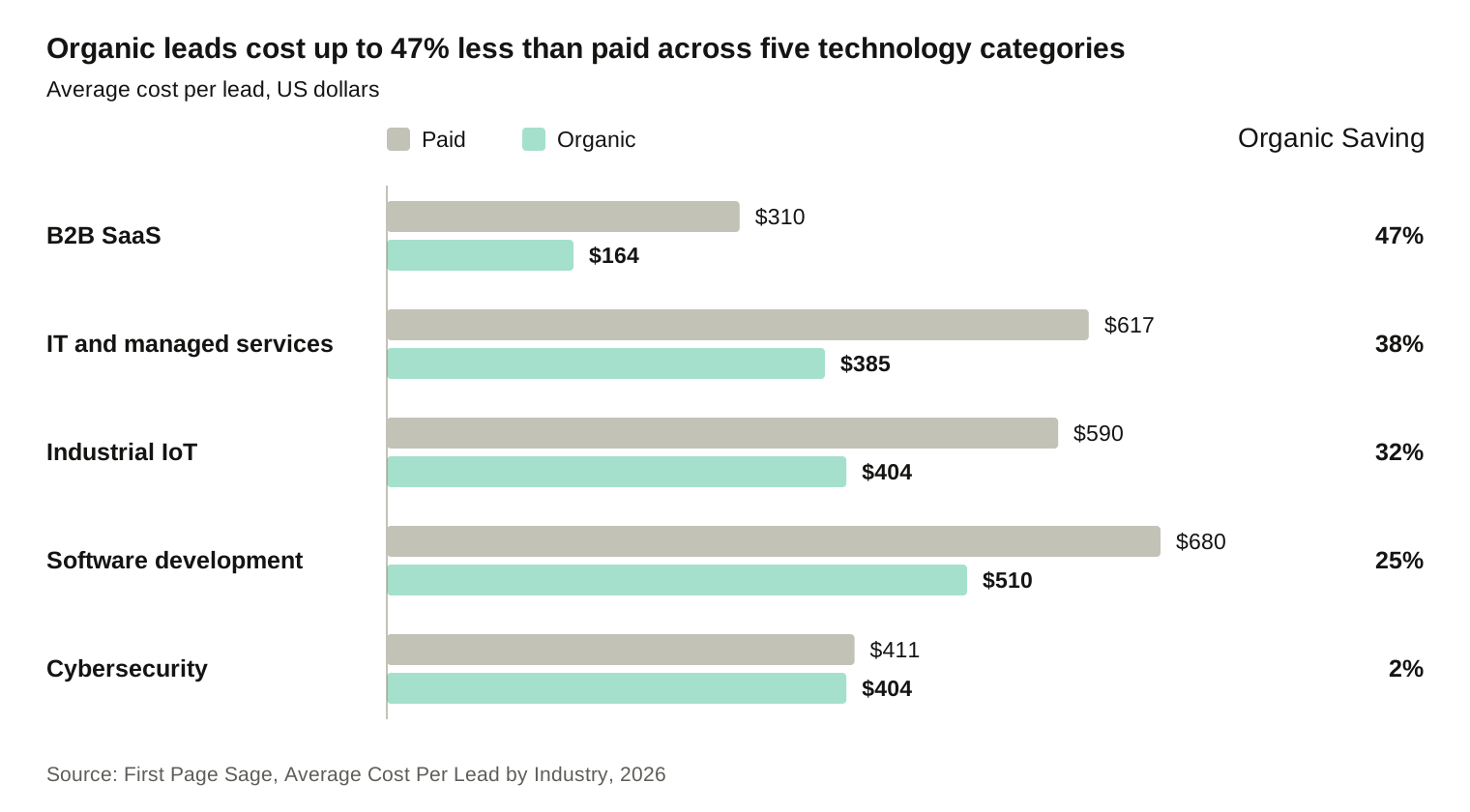
Source: Average Cost Per Lead by Industry, 2026, First Page Sage, updated December 2025
Two caveats keep the comparison honest. "Organic" here means unpaid channels such as search content and speaking engagements, which is the closest published proxy for earned and owned rather than an exact match.
And organic takes longer to pay back, while in a few categories, cybersecurity among them, the saving nearly disappears. The same report still concludes that organic channels return more over time, because the leads arrive closer to a decision.
Paid media buys speed and volume; earned and owned media help build a qualified pipeline.
Measuring the traffic earned and owned media send your way
As with any marketing strategy, measurement is essential.
It’s a good idea to ask the AI assistants that your buyers use to recommend a vendor in your category and see whether you are named, how you are described, and which sources they cite. That ten-minute test tells you more about next year's pipeline than last quarter's click-through report. The findings here should play a role in your communications program to close the gaps.
The twelve stats above describe one chain. The cycle goes: 1) Buyers settle on a shortlist before they speak to anyone, and 2) AI assembles much of what they know and draws on earned coverage and substantive owned content — neither of which a vendor can buy (outside of the expert services used to clinch earned coverage or create the owned content).
Paid media still has a job; capturing demand that already exists, but it’s no longer the concentration of where that demand gets created.
Tools really help. Two kinds of tools show whether communications is producing qualified inbound. One tells you which companies are arriving, the other tells you where the traffic comes from and how you compare with competitors. Used together with your own web analytics, they connect a piece of coverage to a named account on your site.
Web deanonymization: understand who is visiting
Most enterprise buyers research without completing a form. Web deanonymization software, also called “visitor identification,” matches anonymous sessions to a company, and in some cases to a person, so you can see which accounts arrived, from which referring source, and what they read to get to you.
- Account-level platforms identify the visiting company and suit enterprise account-based (ABM) programs. Sample vendors: 6sense, Demandbase, ZoomInfo (WebSights), Dealfront (formerly Leadfeeder) and HubSpot Breeze Intelligence (formerly Clearbit).
- Person-level tools attempt to identify the individual visitor. Sample vendors: RB2B and Warmly. Coverage is strongest in the US (and person-level matching carries more privacy exposure, so it must first be checked against GDPR and your legal counsel).
The report to build is simple: target accounts that arrived from an earned or AI source, by week, set against the coverage and content published that week. Match rates and accuracy vary by vendor, so you should test on your own traffic before committing.
AI search visibility and optimization: see traffic origins and competitive insights
Semrush's Traffic & Market Toolkit breaks any domain's traffic into channels, including Referral, Organic Search and a dedicated AI Traffic channel covering visits from assistants such as ChatGPT, Gemini, Claude, Copilot, or Perplexity. This enables you to benchmark your share of referral and AI-driven traffic vs. named competitors, and see which referring sites send them visitors that you are missing. Its AI Visibility Toolkit tracks how often AI platforms mention your brand for the prompts you choose.
Semrush's traffic figures are estimates modeled from clickstream data, so they should be used for competitive comparison and trend insights, leaning on your own analytics for actual counts.
Collaborate to sum up insights: comms + web + demand generation
The era of AI search demands that multiple marketing team functions collaborate to understand tool analytics, including grouping referrals from publications, analyst sites, review sites, and AI assistants into one “earned and AI” channel. (It’s also helpful to have the Contact Us website form include an open-ended field titled “How you heard.”) Best practices include:
- Use deanonymization to see which target accounts arrive through that channel and what they do next.
- Use Semrush quarterly to check whether your share of referral and AI traffic is rising against a few top competitors.
- Report pipeline from those accounts beside paid-sourced pipeline, using the same cost-per-lead definition for both (This one can be nuanced and tricky).
The above dynamic dozen data points signal just one of many evolutions in the B2B marketing mix as AI shakes up how and where our target buyers find us.
Contact me to explore earned and owned strategies that draw the right traffic to your brand. Thought leadership is my wheelhouse.
Article sources
All figures were published between November 2025 and July 2026. Several come from companies with a commercial interest in the findings, so each is linked to check the methodology.
- Forrester, The State Of Business Buying, 2026
- 6sense, 2025 Buyer Experience Report
- Muck Rack, What Is AI Reading? May 2026
- Seer Interactive, AIO Impact on Google CTR: September 2025 Update
- Ahrefs, Update: AI Overviews Reduce Clicks by 58%
- TrustRadius, 2026 B2B Buying Disconnect Report (via HG Insights)
- Gartner, 2026 CMO Spend Survey
- G2, The Answer Economy
- Microsoft Clarity, AI Traffic Converts at 3x the Rate of Other Channels
- First Page Sage, Average Cost Per Lead by Industry, 2026